Your Dental Plan Must Pay Your Orthodontist Directly Starting January 2027
Direct Answer: Starting January 1, 2027, California regulated dental plans must honor your signed assignment of benefits and pay your orthodontist directly, even out of network, and give you clearer cost information before treatment begins.
If you have ever sat down for a braces estimate at an out of network office, you already know the part that stings. The office asks for the full treatment fee, your plan mails a reimbursement check to you weeks or months later, and in the meantime your family is floating thousands of dollars.
That is changing. Governor Newsom signed AB 1629 on September 27, 2026, and the rules take effect January 1, 2027.
I field a lot of insurance questions from families across Huntington Beach and Fountain Valley, and this is the first change in years that actually moves money in the patient's favor. Below is what the law says, what it does not do, and how to use it before you start treatment.
What the California Dental Assignment of Benefits Law 2027 Actually Requires
An "assignment of benefits" is a short form you sign that tells your plan to send its payment to your provider instead of to you. For years, many California plans simply ignored that form if the provider was out of network.
Starting January 1, 2027, California regulated dental plans and insurers have to honor it. The law, sponsored by the California Dental Association, does three main things:
- Plans must honor a patient's signed assignment of benefits and pay a dentist or orthodontist directly, even when that provider is out of network
- Plans must give patients clearer information about network status and expected out of pocket cost before treatment starts
- Dental insurers must report provider network data to state regulators for all the plans they sell
You can read the signing announcement in the Governor's legislative update from September 27, 2026.
The practical effect for an orthodontic patient is cash flow. Instead of charging you 100% of treatment costs upfront and leaving you to chase the plan, the office has the option to receive the plan's share directly. You pay your part, not the whole thing and then wait.

What It Means for Braces and Invisalign Costs in Huntington Beach and Fountain Valley
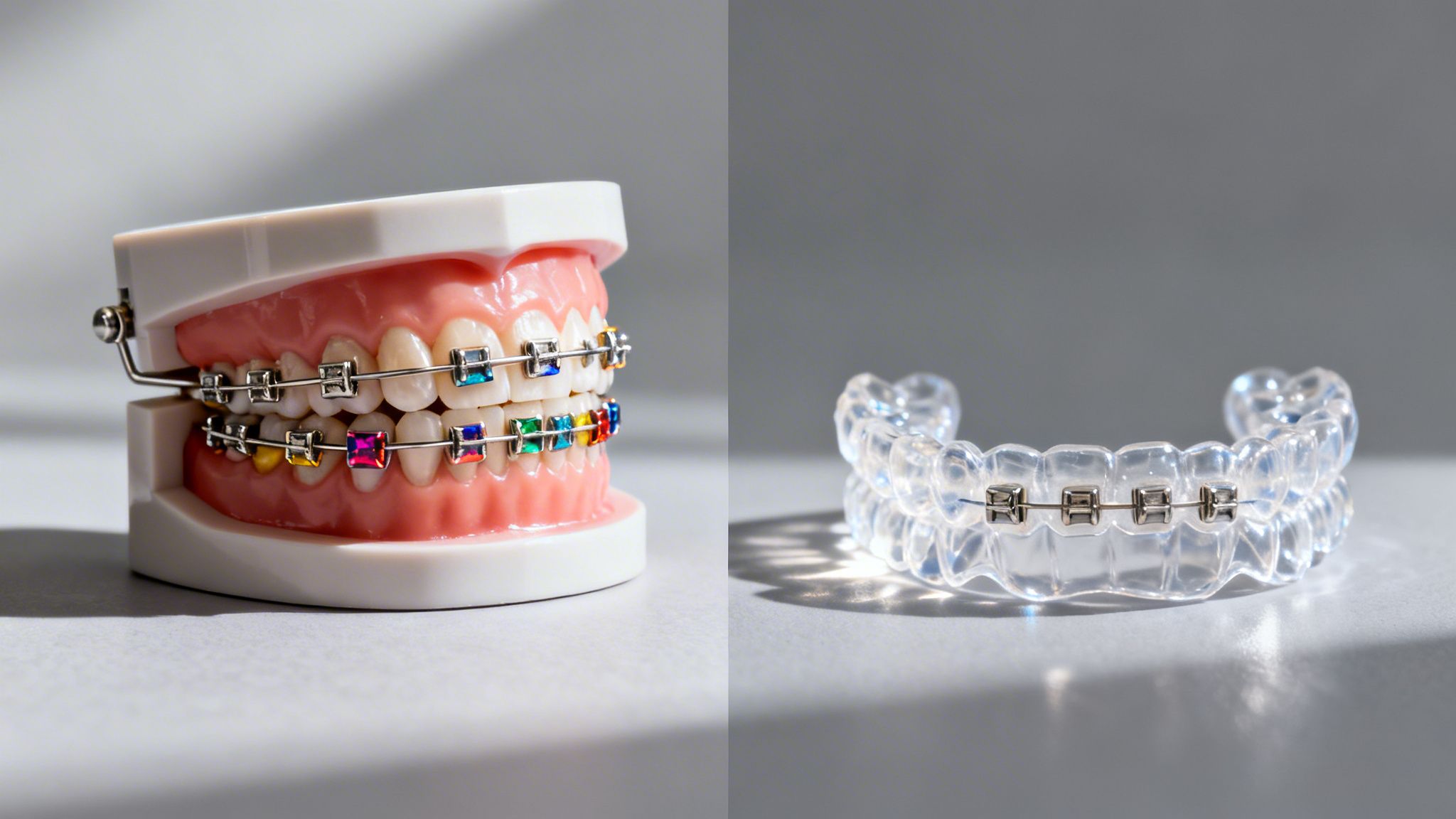
Orthodontic treatment is one of the larger health purchases a family makes, and it usually runs a year or two. Costs swing widely based on how much tooth movement is needed, whether it is Phase 1 care for a younger child or full treatment for a teen, and whether you choose clear aligners, metal braces, or champagne-colored Iconix brackets. I will not quote you a number here, because an honest number only comes after a doctor looks at your teeth.
What I can tell you is how plans usually behave. Most dental plans treat orthodontics differently from the rest of your coverage:
- Orthodontic benefits often come with a lifetime maximum instead of an annual one
- Plans commonly cover a percentage of the fee up to that cap, not the whole fee
- Many plans pay in installments across treatment rather than all at once
- Some have age limits or waiting periods that affect adult patients
So the dollar amount your plan owes does not change on January 1. What changes is who holds the money while treatment happens.
For a family in Oak View or Talbert Village stretching a budget across school costs and a second child who may need treatment later, that difference is real. If you are comparing plan types before open enrollment, our breakdown of HMO versus PPO dental plans for braces covers how each one handles orthodontic coverage.
Paying for Treatment Before and After January 1, 2027
Here is a side by side look at how the same out of network situation plays out under the old rules and the new ones.
| Situation | Before January 1, 2027 | Starting January 1, 2027 |
|---|---|---|
| Out of network orthodontist | Office may require the full fee upfront | Plan must honor your signed assignment of benefits and can pay the office directly |
| Who gets the plan's check | Often mailed to you, then you pay the office | Can go straight to the provider |
| Cost estimate before starting | Varies by plan and office | Plans must give clearer information on your potential financial responsibility |
| Knowing network status | Often unclear until a claim is processed | Plans must tell you the provider's network status before treatment |
| Your total benefit amount | Set by your plan's orthodontic maximum | Unchanged by this law |
What This Law Does Not Change
I want to be straight about the limits, because I have already heard people assume more than the law delivers.
- It does not increase your orthodontic benefit. Your lifetime maximum and coverage percentage stay exactly the same.
- It does not make an out of network office charge in network rates. You are still responsible for the balance your plan does not cover.
- It does not cover every plan on the market. The requirement applies to California regulated dental plans and insurers. Many large employers self fund their dental coverage under federal rules, so if you work for a national company, ask your HR or plan administrator whether your plan falls under state regulation.
- It does not replace a payment plan. In house monthly payment arrangements still matter, and for most families they do more month to month than the assignment of benefits rule does.
One more thing worth saying plainly. A better payment process is not a reason to pick a provider. The reason to pick one is the treatment plan, the doctor, and how clearly they explain the options to you. If you are weighing offices right now, these questions to ask an orthodontist are a better filter than any insurance detail.
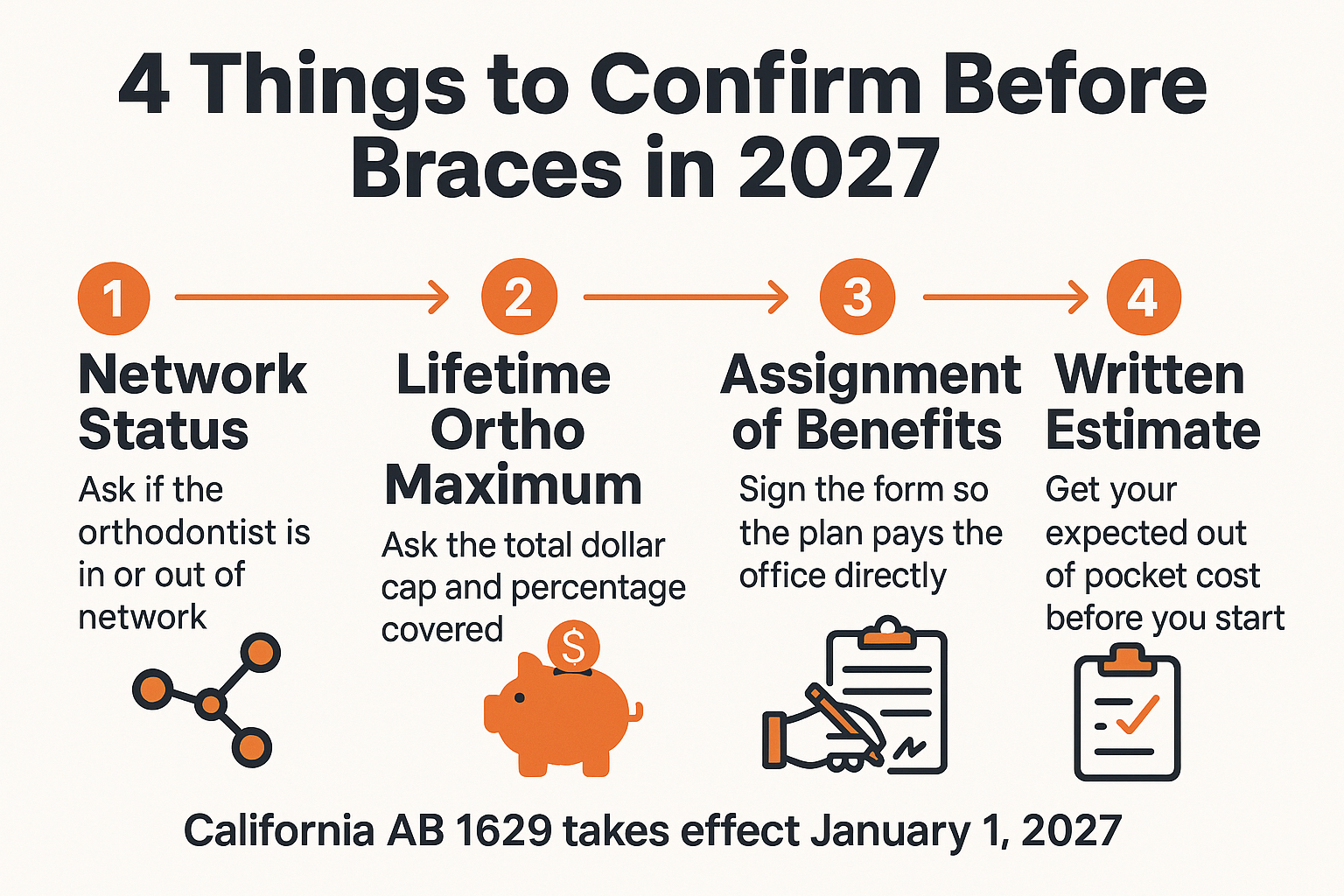
Four Things to Confirm Before Treatment Starts in 2027
Use this short checklist on the phone with your plan, before your consultation or right after it.
How to Use the New Rules at Your Consultation
The part of this law that will help you most is the one nobody is talking about: the requirement that plans give you clearer information about your likely out of pocket cost before treatment starts.
Use it. Here is the order I would go in:
1. Have your consultation first and get the actual treatment plan, since the plan drives the fee. 2. Ask the office for a written treatment estimate and the insurance codes they will submit. 3. Call your plan with those codes and ask for your orthodontic lifetime maximum, your coverage percentage, and the provider's network status. 4. Sign the assignment of benefits form at the office so the plan's share can be sent directly to them. 5. Then decide, with a real number in front of you instead of a guess.
That sequence also protects you from the thing I hear most from comparison shoppers who call us. People get a flat price over the phone from one office, a different flat price from another, and no explanation of what is actually included. A number without a diagnosis behind it is not a quote.
Dr. Jeremy and Dr. Melissa build each plan around the specific case, whether that is Invisalign First for a seven year old in Goldenwest, Iconix brackets for a teen who wants something subtler than silver, metal braces for a case that needs them, or a focused touch-up for an adult who only wants one or two teeth corrected. If cost is your main hurdle, our guide to finding affordable orthodontic care near you walks through the factors that move the final number.
Frequently Asked Questions About the 2027 Assignment of Benefits Law
Does this mean my braces will cost less in 2027?
No. The law changes who gets paid and when, not how much your plan covers. Your lifetime orthodontic maximum and coverage percentage stay the same. The benefit is that you may no longer have to front the entire cost and wait months for a reimbursement check.
What if my orthodontist is out of network with my plan?
That is exactly the situation this law was written for. Starting January 1, 2027, a California regulated plan has to honor your signed assignment of benefits and can pay the out of network provider directly. You are still responsible for whatever your plan does not cover.
I already started treatment in 2026. Does this apply to me?
Ask your plan directly, since the requirement takes effect on January 1, 2027 and how a plan applies it to in progress orthodontic claims can vary. If you are mid treatment and paying out of pocket while waiting on reimbursements, it is worth a call to your plan in January.
Am I too old for this to matter? I am in my sixties.
Treatment age has nothing to do with the law, and plenty of adults start orthodontics later in life. We treat patients well into their seventies. The one insurance detail to check is whether your plan has an age cap on orthodontic benefits, because some do, and that is a plan rule rather than a treatment rule.
What if I am transferring treatment from another orthodontist?
Transfers happen often, especially for people who just moved to Huntington Beach or Fountain Valley. Bring your records and your remaining benefit information, because your previous office has usually already used part of your lifetime orthodontic maximum, and that affects what is left for the rest of your treatment.
Want a Clear Number Before You Decide?
If you have been holding off on treatment because the insurance side felt like a black box, 2027 is a reasonable time to revisit it with a real estimate in hand. Our team on Beach Boulevard sees families from Downtown Huntington Beach, Newland, Adams, and across Fountain Valley, and consultations are available during the week with Saturday appointments by request. You can reach us at 714-594-5777 or at magicfoxsmiles.com whenever you are ready to talk it through.