Invisalign Pricing in Huntington Beach: What Actually Drives the Cost
Direct Answer: Invisalign cost in Huntington Beach varies based on case complexity, number of aligner sets, and refinement needs. Insurance with an orthodontic benefit often applies, and flexible payment plans are widely available.
One of the most common questions I hear from patients who reach out before their first visit is some version of: "What's the number?" They've already Googled Invisalign cost, seen a wide range of figures, and now they're more confused than when they started. I get it, when you're budgeting for something real, vague answers feel like a runaround.
The honest truth is that Invisalign cost genuinely varies from person to person, and that's not a dodge. The price is tied directly to how complex your case is, how many sets of aligners your treatment requires, and whether refinements are needed along the way. Two people sitting in the same waiting room on Beach Boulevard can have treatment plans that look nothing alike.
This article breaks down what actually drives the price, how insurance coverage works in the real world, and what options exist to make monthly payments feel manageable. By the end, you'll have a much clearer picture of what to expect, and the right questions to ask when you come in.
Why Invisalign Costs Differ From Case to Case
When patients ask me for a ballpark, I always explain that Invisalign isn't priced like a flat-rate service. The cost reflects how much work your teeth actually need.
A patient with mild crowding on the bottom row might need a relatively small number of aligner sets and finish in under a year. A patient with multiple gaps, a bite issue, and spacing concerns across both arches will need significantly more aligners, more time, and possibly refinement rounds after the initial series is done. Each of those factors adds to the total.
Here's what tends to move the price:
- Case complexity, mild crowding costs less to treat than a significant bite problem or multiple tooth movements
- Number of aligner sets, more trays means more Invisalign lab cost, which flows through to the treatment fee
- Refinement rounds, if your teeth need additional fine-tuning after the original series, that extends treatment and can affect price depending on how the plan is structured
- Treatment scope, a full comprehensive case costs more than a focused touch-up for someone correcting just one or two things
For adults in their 30s and 40s who've been putting this off, the cost concern is real and I won't pretend otherwise. But thinking of Invisalign as a one-time purchase misses what it actually is: a multi-month to multi-year investment in how you look and feel every day. When you break it into a monthly payment, it often compares favorably to other things people spend money on without much thought.
For a deeper look at how Invisalign stacks up against braces from a cost standpoint, the Invisalign cost vs. braces breakdown on our blog is worth reading.
How Insurance Actually Works for Invisalign
Insurance questions are probably the single biggest source of hesitation I see before patients book. Several people have submitted forms or called specifically to confirm whether their Delta Dental PPO, Guardian, or MetLife plan would apply, and in many cases, getting a clear answer on that was all it took for them to move forward.
Here's the core thing to understand: most PPO plans that include an orthodontic benefit will apply that benefit to Invisalign exactly the same way they'd apply it to braces. Invisalign is not automatically excluded just because it's clear aligners. The real variable is whether your specific plan has a lifetime orthodontic maximum, and how much of it has already been used.
Before your consultation, it's worth calling your insurance company and asking three specific questions:
- Does my plan include an orthodontic benefit?
- What is my lifetime orthodontic maximum?
- Has any of that maximum been used by previous treatment?
That last question matters especially for patients who had braces as a teenager and are now considering Invisalign as adults. Most orthodontic benefits are lifetime maximums, not annual ones, so if your plan paid out a portion during your teen years, that amount is no longer available. Some benefit may still remain depending on the plan and how much was used. This is worth knowing before you walk in, because it shapes what your out-of-pocket cost will look like.
If you'd rather not navigate that call on your own, we can help verify your benefits before your consultation appointment.
Three Questions to Ask Your Insurance Company Before Your Consultation
Before calling your insurance provider, know which questions actually matter. This infographic covers the three that cut through the confusion.

Making Invisalign Affordable: Payment Plans, HSA, and FSA
Cost is one thing. Cash flow is another. And for many patients in the Huntington Beach and Fountain Valley area, the monthly payment matters far more than the total number.
Flexible payment plans are one of the most practical ways orthodontic care becomes accessible to people who can comfortably handle a monthly amount but can't write a large check upfront. One patient who finished treatment with us put it plainly in a review, saying the affordable plans made treatment possible for her during a stretch when money was tight. That kind of access matters, and it's something Dr. Jeremy and Dr. Melissa have made a priority.
Beyond standard payment plans, there are two options that a surprising number of working adults in Orange County don't think to use:
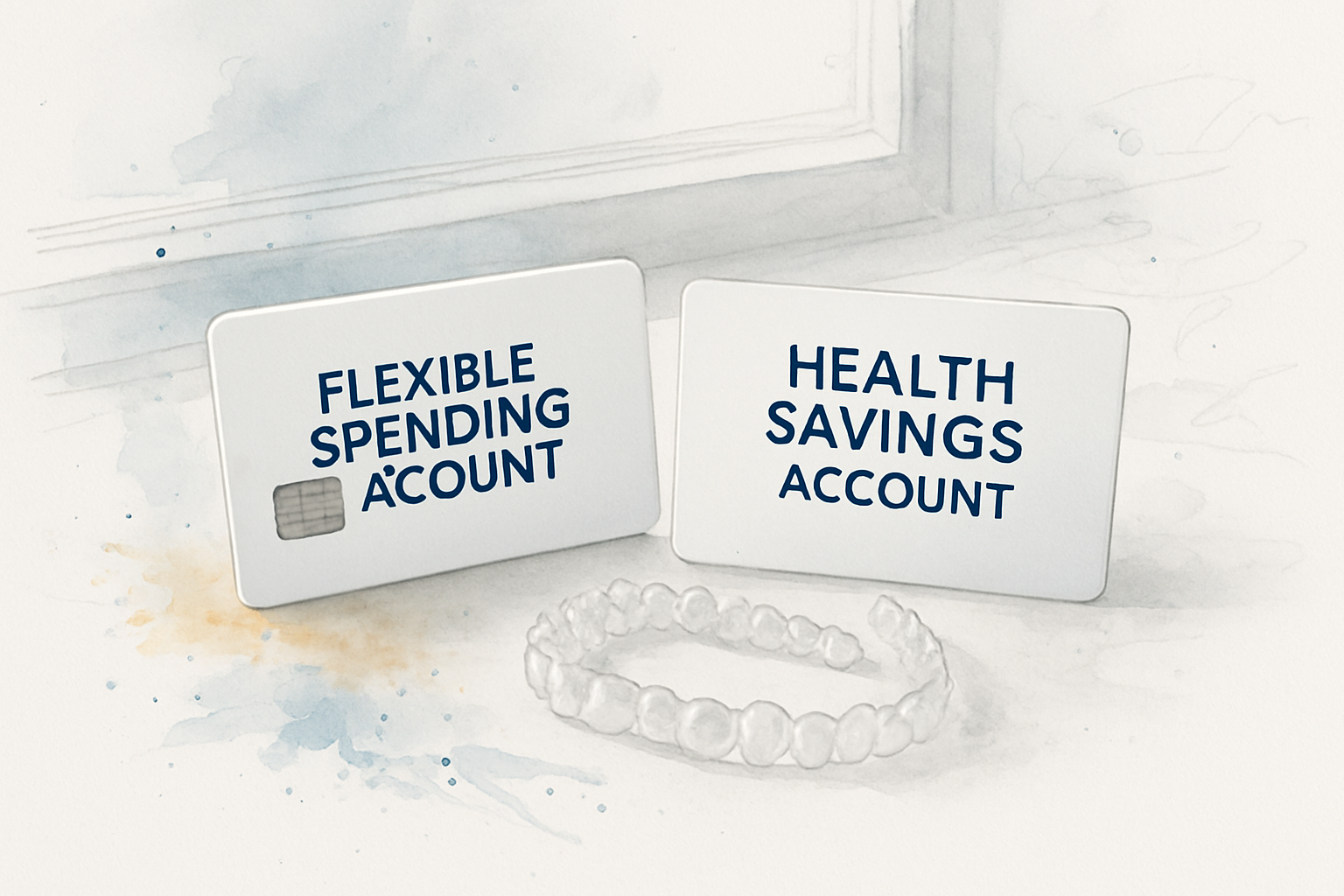
- HSA (Health Savings Account), If you have a high-deductible health plan, your HSA dollars can typically be used for orthodontic treatment. This is pre-tax money, which means every dollar you spend through an HSA goes further than a dollar out of your regular checking account.
- FSA (Flexible Spending Account), Similar pre-tax advantage, but with an important timing detail: FSA funds typically expire at the end of the calendar year (or shortly after, depending on your plan's grace period). If you have a balance sitting in an FSA and haven't used it, starting treatment before December 31st is a natural deadline worth paying attention to.
Using pre-tax dollars effectively reduces what Invisalign costs in real terms. If you're in a combined federal and state tax bracket of around 30 percent, every $1,000 you spend from an HSA or FSA effectively costs you closer to $700 in actual take-home purchasing power.
For a fuller explanation of how HSA funds apply to orthodontic care, the IRS guidance on HSA-eligible expenses is the most reliable reference point.
You can also read more about this topic in our post on using HSA for orthodontics.
Factors That Push Invisalign Cost Up or Down
No two treatment plans are identical, but these are the variables that consistently influence where your case lands on the cost spectrum.
| Factor | Lower Cost Scenario | Higher Cost Scenario |
|---|---|---|
| Case complexity | Mild crowding, one arch | Bite correction, multiple tooth movements |
| Number of aligner sets | Fewer trays, shorter treatment | More trays, longer treatment |
| Refinement rounds | None needed | One or more additional series |
| Treatment scope | Focused touch-up (1-2 issues) | Full comprehensive treatment |
| Insurance coverage | PPO with remaining ortho benefit | No ortho benefit or benefit already used |
| Payment method | HSA or FSA pre-tax dollars | All out-of-pocket after-tax |
The Patient Who Already Had Braces Once
This comes up more than you might think. A patient had braces as a teenager, life got busy, the retainer stopped getting worn, and now the teeth have shifted. They want to know two things: can it be fixed, and will insurance cover any of it the second time around?
On the first question, yes, teeth that have shifted after previous treatment can generally be retreated. The scope depends on how much movement has occurred. In some cases, a focused touch-up approach (correcting just one or two specific things) may be enough. In others, a more involved plan is needed. That determination only comes from an actual clinical evaluation.
On the insurance question, I can be honest but not definitive: most orthodontic benefits are lifetime maximums. If insurance paid toward your original braces, that amount counts against the lifetime cap. Whether there's any remaining benefit depends entirely on your specific plan and how much was used years ago. Some patients have remaining benefit. Many don't. The only way to know is to call your insurance company and ask directly, using the same three questions listed earlier in this article.
This is a reader who deserves a straight answer, not reassurance. The situation is common, the path forward exists, and the consultation is the right first step to figure out where you actually stand.
For adults thinking through this kind of scenario, our post on adult Invisalign cost covers the broader financial picture in more depth.
Why a Free Consultation Gives You Something a Website Can't
I know some people call just to get a number. And I understand the impulse, if the price is way out of range, why bother making an appointment? But here's what the phone call or a website number actually can't tell you:
- What your specific treatment scope looks like
- Whether your insurance has remaining orthodontic benefit and how much
- What a realistic monthly payment would be for your case
- Whether a focused touch-up approach might cost significantly less than full treatment
A consultation with Dr. Jeremy or Dr. Melissa is where all of that becomes clear. It's not a sales step, it's the only accurate way to price your specific situation, because no two mouths are identical and Invisalign pricing reflects that reality.
Patients who come in thinking they know the number often leave surprised, sometimes because the cost is less than expected for their particular case, and sometimes because insurance covers more than they assumed. Either way, they leave with actual information instead of a generic range they found online.
If you're curious about what happens at that first visit, our frequently asked questions page covers the process in plain terms. And if you want to read about the experience from patients who've been through it, the success stories page gives a real picture of what treatment looks like from start to finish.
Frequently Asked Questions About Invisalign Cost in Huntington Beach
Can you give me a price over the phone before I come in?
Not one that's actually useful to you. Invisalign pricing is tied to how complex your case is, how many aligners you need, and whether refinements will be required. A number without that context doesn't mean anything. The consultation is free, and it's the only way to get a figure that applies to your specific teeth.
Does Delta Dental PPO cover Invisalign?
Many Delta Dental PPO plans do include an orthodontic benefit that applies to Invisalign. But coverage varies by plan, and the key question is whether you have a remaining lifetime orthodontic maximum. Call Delta Dental directly, ask what your lifetime ortho max is, and ask whether any of it has been used. That gives you a real number to work with before your appointment.
I had braces as a teen. Will insurance cover Invisalign now?
Possibly, but it depends on whether your plan has any remaining lifetime orthodontic benefit. Most orthodontic coverage is a lifetime maximum, not an annual one, so if insurance contributed to your original braces, that amount counts against the cap. Some benefit may still remain. Your insurance company can tell you exactly where you stand.
Can I use my HSA or FSA to pay for Invisalign?
Yes, in most cases. Orthodontic treatment is generally an HSA and FSA eligible expense. Using pre-tax dollars effectively reduces your real out-of-pocket cost. If you have an FSA, keep in mind that funds typically expire at year-end, so timing matters. Ask us about applying those funds when you come in for your consultation.
What if I only want to fix one or two things, do I have to pay for a full treatment plan?
Not necessarily. Beginning in July, we offer a focused touch-up option specifically for patients who want to address one or two specific concerns rather than commit to comprehensive treatment. Whether that applies to your situation depends on the clinical evaluation, but it's worth asking about if your concerns are limited.
Am I too old to start Invisalign?
No. We treat patients well into their 70s. One patient in her mid-70s from the Huntington Beach area recently completed treatment and described the results as well worth it. Age is genuinely not a barrier for orthodontic care, as long as your teeth and gums are healthy enough to support treatment, which Dr. Jeremy and Dr. Melissa will assess at your consultation.
Ready to Get a Number That Actually Applies to You?
If you're in Huntington Beach, Fountain Valley, or anywhere across the surrounding neighborhoods and you've been putting this off because the cost felt uncertain, a free consultation with Dr. Jeremy and Dr. Melissa is the most practical next step. You'll leave knowing your treatment scope, what your insurance may cover, and what a monthly payment could look like, none of which a website number can tell you. Reach out at 714-594-5777 or visit magicfoxsmiles.com to schedule.