Your FSA or HSA Can Pay for Braces. Here's What That Means.
Direct Answer: Yes, FSA and HSA funds can pay for braces, Invisalign, retainers, and consultations, and using pre-tax dollars meaningfully lowers your real out-of-pocket cost for orthodontic care.
Insurance questions are the number one thing that slows families down when they call about braces or Invisalign. We hear it constantly: 'Do you take my insurance?' before anything else even comes up. But there's a second financial tool that most people in Huntington Beach and Fountain Valley have access to and rarely think to ask about, an FSA or HSA.
These accounts let you pay for orthodontic treatment with pre-tax dollars, which means the money you set aside goes further than cash out of your checking account. And for families where home costs already stretch the budget, that difference adds up fast.
This article answers the specific questions I hear most often from patients and parents who are trying to figure out how to actually pay for treatment, before they commit to anything.
What Exactly Is an FSA, and What Is an HSA?
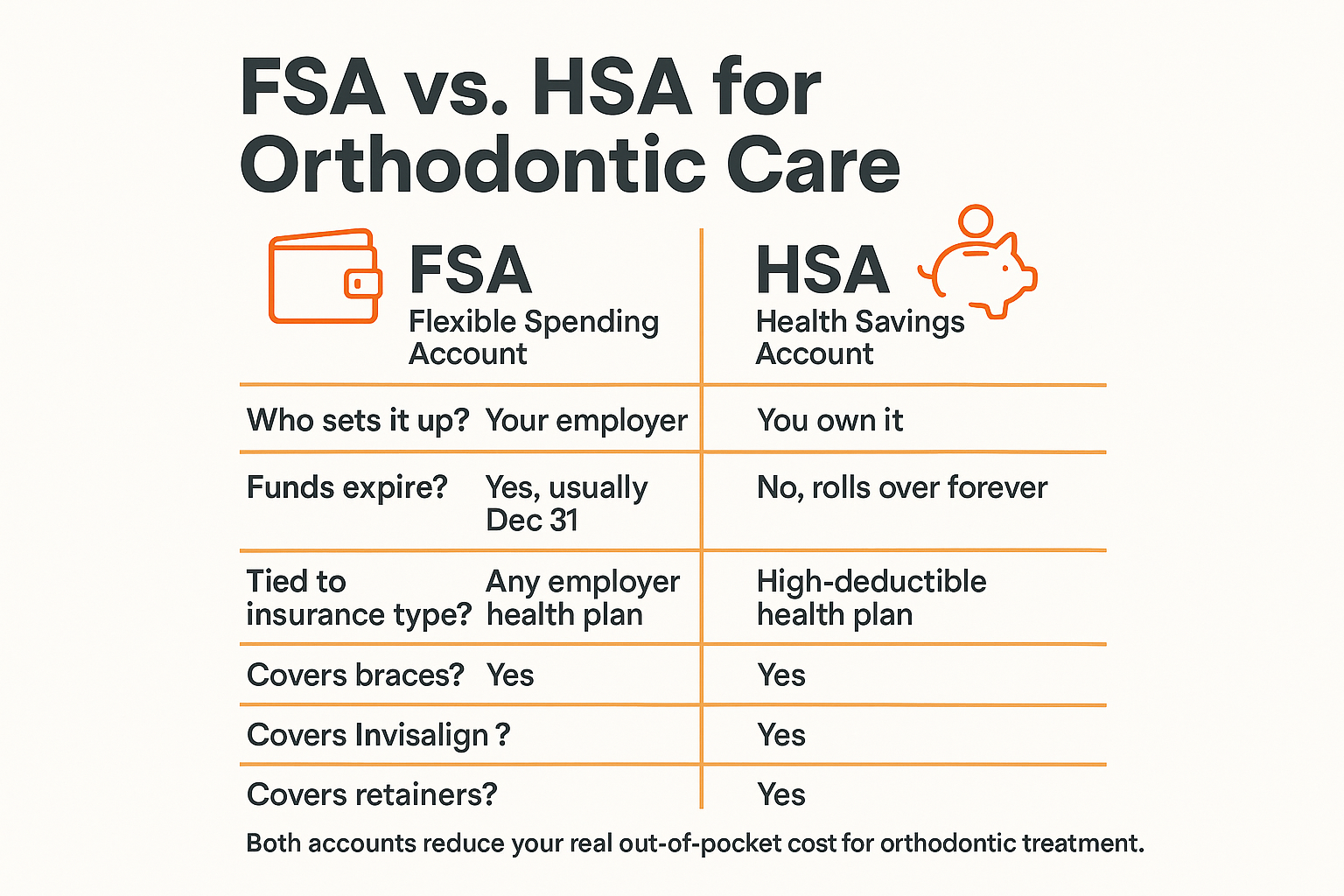
These two accounts get lumped together a lot, but they work differently, and knowing which one you have changes your strategy.
An FSA (Flexible Spending Account) is employer-sponsored. Your company sets it up, you elect how much to contribute at the start of the year, and that money comes out of your paycheck before taxes. The important catch: most FSAs follow a use-it-or-lose-it rule. If you don't spend the funds by your plan's deadline, usually December 31, though some plans offer a short grace period, the balance is gone.
An HSA (Health Savings Account) is different. You own it. It's tied to a high-deductible health plan, contributions roll over year after year with no expiration, and the money grows if you invest it. HSA funds don't disappear on January 1, they're yours to use whenever the time is right.
Both types of accounts cover orthodontic expenses. The American Association of Orthodontists confirms that most orthodontic services, from your first consultation through your final retainer, qualify as eligible expenses under both FSA and HSA rules.
What Orthodontic Costs Are Actually Covered?
This is where a lot of people assume the coverage is narrower than it actually is. Both FSA and HSA funds can be applied to:
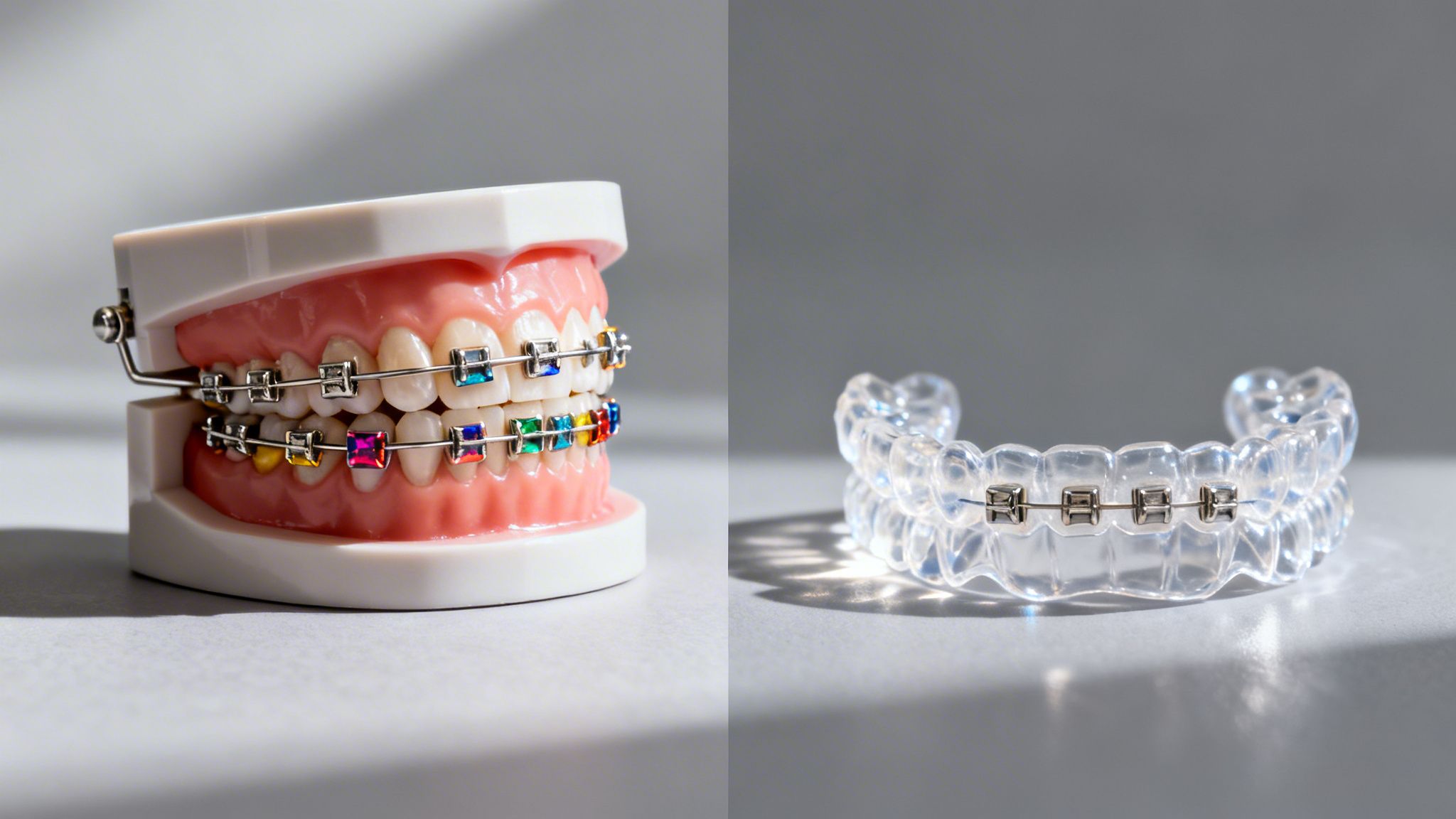
- Braces, traditional metal or Iconix esthetic brackets
- Invisalign clear aligners, including Invisalign First® for younger patients in Phase 1 treatment
- Retainers, both at the end of treatment and replacements later
- Initial consultations, yes, even the first visit typically qualifies
- Touch-up treatment, focused correction of one or two specific concerns
That last one surprises people. If you're only looking to address one or two things rather than committing to a full course of treatment, the focused touch-up option we offer starting in July is still an eligible orthodontic expense. You don't have to be in comprehensive treatment for your FSA or HSA to apply.
The key is that the treatment must be for corrective or health-related purposes, and orthodontic care qualifies on that basis.
FSA vs. HSA: A Quick Side-by-Side
Here's a plain comparison of how these two accounts work so you can quickly see which applies to your situation.
Can I Use an FSA or HSA Alongside My Insurance?
Yes, and this is the combination that most families aren't using to its full potential. Think of it as a layered system rather than an either-or choice.
Here's how the layers typically work:
1. Insurance pays first, your Delta Dental PPO, Aetna, Anthem, or MetLife plan covers its contracted portion of the treatment fee. 2. Your FSA or HSA covers part of what's left, whatever your insurance doesn't pay, pre-tax account funds can often offset. 3. A payment plan spreads the rest, if there's still a remaining balance after insurance and your FSA or HSA, a monthly payment arrangement can make that amount very manageable.
One caller asked us specifically whether insurance and payment plans could be combined before they would even schedule. The answer is yes, and adding an FSA or HSA on top of that makes the math even more favorable.
For families across Huntington Beach and Fountain Valley, where a meaningful portion of household income goes toward housing, using every available pre-tax dollar for orthodontic care is just smart planning, not a workaround.
What If My Treatment Spans Two Calendar Years?
This is a genuinely good question and one I want to answer carefully, because it trips people up.
If your child starts braces in October and finishes the following December, your treatment crosses two plan years. With an HSA, this isn't an issue at all, funds roll over, so there's no timing pressure.
With an FSA, most plans allow you to use funds for expenses incurred during the plan year, regardless of when the full treatment finishes. Some orthodontic offices receive the full contract amount up front, which can be treated as a single expense in the year it's paid. Others bill in stages. How yours is structured matters for FSA planning.
The practical advice: talk to your FSA administrator before starting treatment to understand how your specific plan handles multi-year orthodontic contracts. We can also give you a written treatment estimate that you can bring to that conversation.
For more on how treatment timelines factor into the overall cost picture, the Invisalign cost article on our blog walks through how fees are typically structured.
When to Use Your FSA: A Timing Guide
If you have FSA funds expiring at year-end, these windows give you the most flexibility for starting orthodontic treatment.
| Time of Year | What to Do | Why It Matters |
|---|---|---|
| January - June | Schedule a consultation and get a written estimate | Time to plan contributions and coordinate with insurance |
| July - September | Start treatment or Phase 1 evaluation | Treatment is underway before the end-of-year crunch |
| October - November | Use remaining FSA funds for treatment deposit, retainers, or touch-up | Funds applied before the typical December 31 deadline |
| December | Confirm balance with FSA administrator, do not wait | Unspent funds in most plans are forfeited after year-end |
Frequently Asked Questions About FSA and HSA for Orthodontic Care
Can I use my HSA for Invisalign specifically, or only for braces?
Your HSA covers Invisalign the same as it covers braces, there's no distinction between treatment types when it comes to eligibility. What matters is that the treatment is for corrective dental alignment, which Invisalign qualifies for. Both Dr. Jeremy and Dr. Melissa are certified Invisalign providers, and they can give you a written fee breakdown you can submit for reimbursement or pay directly with your HSA card.
Can I use my FSA for my child's braces, or is it only for my own treatment?
You can use your FSA for a dependent child's orthodontic care. Your child doesn't need their own account, treatment for a qualifying dependent is an eligible expense under your plan. This applies to traditional metal braces, Iconix esthetic brackets, and Invisalign First® for younger patients in Phase 1 treatment.
Someone told me FSA funds expire at the end of the year. Is that true?
For most FSA plans, yes. Unused funds typically expire on December 31, though some employers allow a grace period of up to 2.5 months into the new year, and others allow a small rollover amount. Check your specific plan, but the general rule is that if you have a balance sitting unused in October or November, starting orthodontic treatment before year-end is a real option worth considering. HSA funds, by contrast, never expire.
What if I want to do touch-up treatment, just fixing one or two things? Does FSA cover that?
Yes. Focused, limited orthodontic treatment still qualifies as an eligible FSA or HSA expense. Starting in July, we offer a touch-up option for patients who don't need or want full comprehensive treatment, just targeted correction of one or two specific concerns. That kind of treatment typically carries a lower overall fee, which also means your pre-tax funds may cover a larger share of it.
Do I need to get pre-authorization from my FSA or HSA administrator before starting?
Generally, no pre-authorization is required for orthodontic care under an FSA or HSA. You pay with your benefits card or submit receipts for reimbursement. That said, some plans want specific documentation, and keeping a copy of your written treatment estimate and any itemized receipts is smart practice regardless.
Is there an age limit on who can use an HSA for orthodontic treatment?
No age limit. Adults well into their 60s and 70s use HSA funds for orthodontic care regularly. One of our patients completed her treatment at 76 and called the experience wonderful. If you have an HSA and you've been putting off treatment because of cost, the account exists precisely for situations like this, use it.
Ready to Put Your FSA or HSA to Work?
If you have FSA funds with a deadline coming up, or an HSA you've been holding off on using, a consultation with Dr. Jeremy and Dr. Melissa is the right first step. We can provide a written treatment estimate you can bring directly to your benefits administrator. Families throughout Huntington Beach and Fountain Valley are welcome to call 714-594-5777 or visit magicfoxsmiles.com to schedule, no commitment required.